A photo documentary titled “A Pain That Persists: Japanese Americans scarred by WWII internments”
http://blogs.sacbee.com/photos/2012/02/a-pain-that-persists-japanese.html
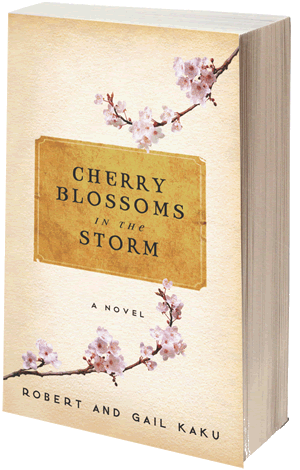
This blog has been created for my upcoming novel Cherry Blossoms in the Storm, a story about the Japanese American experience during World War II.
Please feel free to provide any inputs you may have to this project.
Here’s a short summary.
Caught in the cataclysm of WWII, three Japanese American brothers and their families take separate paths to survive. In Japan, the eldest brother is forced to serve in the Japanese army. In America, the middle brother joins the U.S. Army, while the youngest resists the draft and goes to prison. They overcome extraordinary challenges to reunite after the war.
A photo documentary titled “A Pain That Persists: Japanese Americans scarred by WWII internments”
http://blogs.sacbee.com/photos/2012/02/a-pain-that-persists-japanese.html
Members of the Kaku-Yamashita family were incarcerated at the Santa Anita Assembly Center (California) and the Heart Mountain War Relocation Center (Wyoming) during the same era as Cherry Blossoms in the Storm. These letters were written by one of our relatives during the internment. Will Kaku (my brother) came across these letters when he spoke with University of California at Davis Professor Cecilia Tsu about her research project on Asian immigrant farming in Santa Clara County. One of her research partners was holding a collection of old photographs. The top one was the photograph shown below. Will believes it was Aunt Itsuyo, depicted second from the right, back row in the photo, and a member of the Wade family on whose ranch our family worked as sharecroppers. The professor said that these letters were found in with Wade family collection at the History San Jose archives. Here’s the link: Kaku-Yamashita letters
Click on the picture for a larger version.
This photo is believed to be taken around 1934 or 1935 at the Wade Ranch in Alviso (now San Jose). My father Shogo (Bill) is standing on the far left.
Because of low finances, the four oldest children (Tetsuo, Tsugio, Toshio, Shizuko) are sent to Japan in 1923 to live with their uncle. The second oldest daughter, Itsuyo, who is only a year old in 1923, is left with her parents in the United States. When their living situation in America improves, the “Kibei” children return to the United States. The oldest child, Tetsuo, returns to the United States in 1932 and the rest of the children, Tsugio, Toshio, Shizuko, return on May 9, 1934.
This is a very interesting and very moving link to a report from Ishinomaki in Tohoku (Northern Japan). You can see that much progress has been made during the last 10 months, but there’s a very long road ahead to recovery.
Here’s the link:
http://www.youtube.com/watch_popup?v=SS-sWdAQsYg&vq=medium
This post was submitted by Gail.
Here’s a video clip about the true story of five Japanese American brothers who fought in WWII–three for the United States and two for Japan.
http://edition.cnn.com/2011/11/08/us/veterans-in-focus-7-brothers-world-war-ii/
NBC Nightly News clip shows Japanese American WWII heroes being awarded.
http://www.msnbc.msn.com/id/3032619/#45141608
This post was submitted by bobkaku.
Japanese Christians in Northern Japan press in and persevere amid the disasters.
KESENNUMA, Japan (AP) — This Easter, the story of resurrection carried a deeply personal message for the small community of Christians in disaster-hit Japan.
http://www.usatoday.com/news/religion/2011-04-24-Easter-Japan-tsunami-_24_ST_N.htm
http://www.youtube.com/watch?v=5aLqsKTWgJk
Out of the internment camps in the interior of the United States, thousands of young Japanese American men enlisted in the army’s 442nd Regimental Combat Team. Despite their families being locked up behind barbed wire, these men went on to serve their country with great distinction.
A section of Cherry Blossoms in the Storm tells their story.